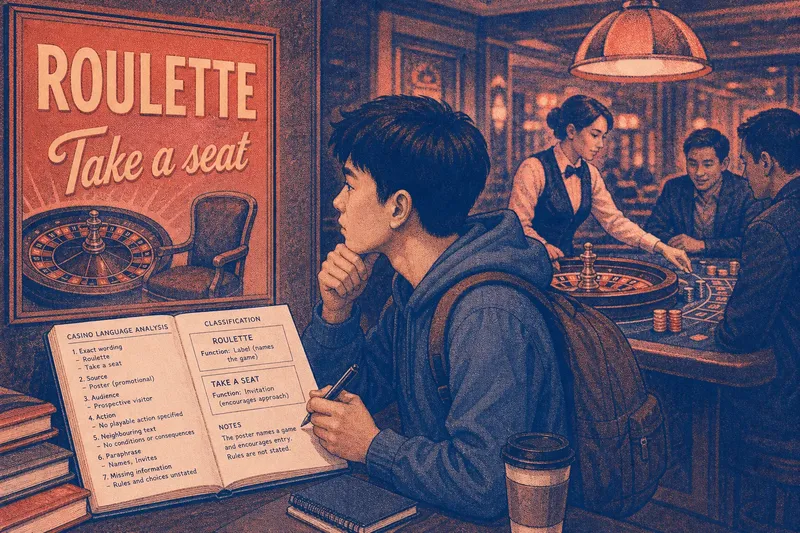
A No-Equipment Plan for a Casino-Scene Reading Session
A no-equipment casino-scene reading session helps NTTU students compare dialogue and game language, leaving with clear notes and without slides or special kit.
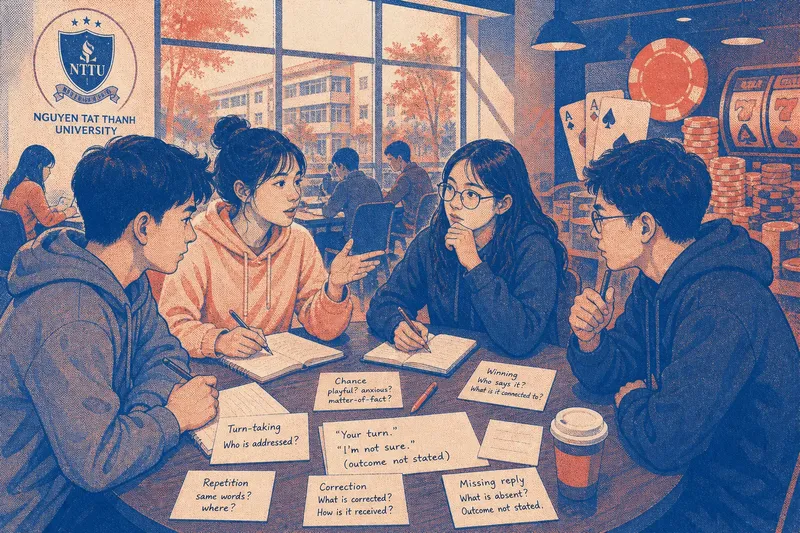
The common mistake in a no-equipment casino-scene reading session is to prepare it like a presentation. The cost is time spent organising slides and props instead of making a useful comparison. For NTTU students, a shared passage and a few lines of individual notes are enough to examine how game language shapes an exchange.
What can students compare without equipment?
Focus on the words characters use around a game: who calls a turn, describes a chance or names a win, and how another character responds. The aim is to discuss dialogue as writing, not to explain game rules or make claims about gambling.
Choose one permitted clip, transcript or remembered passage that the group can access without special equipment. Agree on the exact exchange before discussing it. If recollections differ, mark the wording as uncertain rather than treating one person’s memory as a transcript.
How can the group organise its notes?
Make each note pair one quoted or paraphrased phrase with a question about its role. A short label is like a label on a storage box: it helps you find the contents, but does not describe everything inside.
- Turn-taking: If a character says “your turn” or equivalent, note who is being addressed; if nobody is named, record that the next speaker is unclear and avoid assigning the line to someone by assumption.
- Chance: If a character uses words such as “lucky” or “chance”, note whether the line sounds playful, anxious or matter-of-fact; if tone cannot be recalled or heard, record the wording without assigning a mood.
- Winning: If someone names a win or loss, note who says it and what the dialogue explicitly connects it to; if the outcome is not stated, leave it open rather than supplying one.
- Repetition: If a phrase is repeated, write down the repeated words and compare their positions; if nothing is repeated, choose a change of speaker or a pause as the next item to discuss.
- Correction: If one character corrects another’s game-related wording, note the correction and the response; if there is no correction, do not infer disagreement from silence alone.
- Missing reply: If a response is inaudible or absent from the passage, mark it as missing; if the reply is present, summarise only what it says and do not extend it into an unseen decision.
For each proposed reading, decide whether the wording supports it, leaves it open or does not support it. If two readings fit the same line, keep both and point to the words each depends on. If neither can be tied to the passage, replace the interpretation with a plain description.
How should a group handle disagreement?
Ask each speaker to point to a particular word, pause or response before explaining an interpretation. Then restate the evidence in neutral terms. This makes it easier to distinguish a disagreement about the text from a disagreement about what someone assumes a character feels.
Say you have an invented passage with the starting details “Your turn”, a reply of “I’m not sure”, and no stated outcome. One student reads the exchange as hesitation because of the reply; another hears a routine handover because of the first line. The group writes both readings beside the exact words, then records the outcome as unknown. Its resulting comparison is that the line assigns a turn while the reply complicates the exchange; it cannot establish what either character does next.
What do students ask about game-language sessions?
Can students discuss game language without knowing the rules?
Yes. Concentrate on how words such as “turn”, “chance” or “win” function in the exchange. Do not treat a character’s line as an explanation of how a real game works.
What if the group remembers different wording?
Use a permitted transcript or clip if available. Otherwise, note the disputed wording as uncertain and compare only the details everyone can recall.
How should an unclear outcome be recorded?
Write “outcome not stated” or identify the missing reply. Do not fill the gap with an imagined result.
What should each student leave with?
A concise note naming the passage, the words discussed, the readings considered and any unresolved point is sufficient. It gives the group a clear basis for comparing another exchange later.
How can students keep the analysis grounded?
Keep claims about the passage separate from claims about real people or venues. A line can frame a moment as playful, uncertain or competitive without establishing what a player believes, or how anyone behaves outside the scene.
For a no-equipment casino-scene reading session, the useful result is a comparison tied to specific language and honest about what remains unknown. That discipline makes a small spoken discussion more informative than a polished account built on details the group never had.