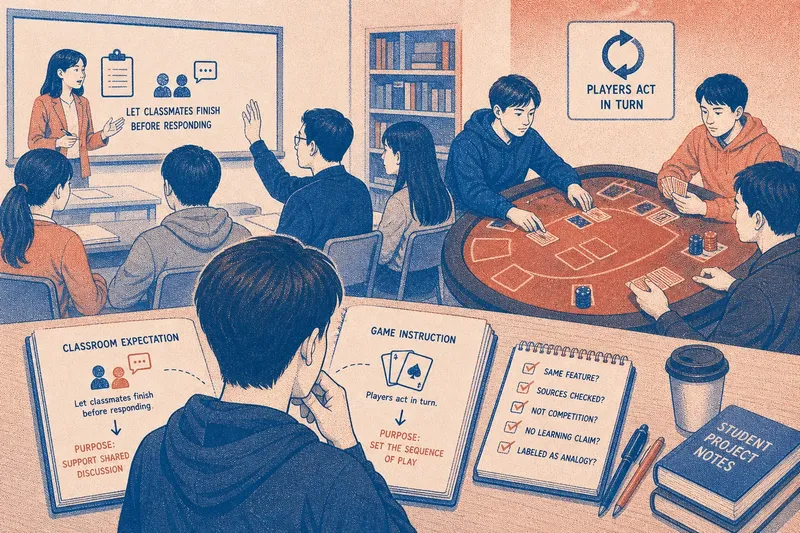
Why a Campus Break Feels Different from a Casino Intermission
Campus break vs casino intermission: learn how each pause fits its setting, so you can describe the interval clearly without implying what happens next.

The common mistake is to treat a campus break and a casino intermission as interchangeable pauses. The phrase campus break vs casino intermission points to a difference in context: one usually sits between study commitments, while the other is presented as part of a continuing event. Mixing the terms can make a gap in a student’s day sound like an organised programme interval.
The action during a pause does not settle the wording. Eating, talking or stepping outside can happen in either setting. What matters is how the pause relates to the surrounding activities.
What makes a campus break distinct?
A campus break belongs to the working structure of a student’s day. It might fall between lectures, before a group meeting or while waiting for a class to begin. Its immediate purpose may be practical: get a drink, eat, speak to a classmate or walk to another room.
It need not be productive. A student can spend the time chatting about a film or looking across the courtyard. The word describes the gap in the day, not the quality of what happens during it.
At Nguyễn Tất Thành University (NTTU), a student might leave a lecture room, walk to the canteen and then attend a tutorial elsewhere. The lecture and tutorial are separate commitments, even if the student’s timetable places them close together.
Why does an intermission belong to an event?
An intermission is conventionally a planned pause within an event, such as a stage performance. The action stops, but the programme is expected to continue. Audience members may stretch, talk or visit the foyer before the next part begins.
Casino settings may also use “intermission” for a pause within leisure activity. The term describes how the pause is framed; it does not mean that a particular person must resume. Someone can leave, even if the surrounding event or venue treats the interval as part of a continuing occasion.
How should you choose between the terms?
Look at the structure around the pause, rather than at the person’s immediate activity. A timetable, programme or announcement can help clarify whether the occasion has a planned interval or whether one commitment has ended and another is due to begin.
The labels are useful distinctions, not rigid rules for every conversation. A day can include a formally organised campus event with an intermission, while a leisure activity can have an ordinary break that is not presented as part of a programme.
- Check whether a lecture has ended and a separate class is due next; if so, call the gap a campus break, but if one event’s programme continues after a stated interval, call it an intermission.
- Check whether the next activity has a separate purpose, such as a tutorial after a lecture; if so, describe the gap as a break, but if the same performance is due to resume, describe its pause as an intermission.
- Check for an announced interval in a programme; if one is listed, “intermission” fits the event’s structure, but if there is no programme and the pause is simply between activities, “break” is clearer.
- Check whether a person has chosen to leave rather than return; if they have ended their participation, say they have left or finished, but if the event is paused and they remain part of it, “intermission” may describe the interval.
- Check whether the pause is tied to a campus timetable; if it falls between scheduled commitments, use “break”, but if it belongs to a continuing leisure event, use “intermission” when that is how the event frames it.
- Check whether the description might imply a return that is not planned; if so, name the person’s action as leaving or ending the activity, but if the programme itself is paused for a later part, “intermission” remains suitable for the event.
Say an NTTU student has a lecture, a group meeting and a meal between them. The starting point is a completed lecture and a separate meeting scheduled afterwards. The student walks to the canteen, eats and then goes to the meeting in another building; each action takes place in the gap between commitments, so “campus break” describes the interval. Now imagine the same student attends a performance with an announced interval, goes to the foyer and returns when the programme resumes. The observable sequence is a pause within one event, so “intermission” fits. In neither case does the label depend on whether the person feels rested.
Which questions help clarify the wording?
Is a casino intermission the same as a campus break?
No. The terms usually describe different relationships to surrounding activities: a campus break falls between commitments, while an intermission is framed as part of an event. The setting and programme provide useful clues.
Can someone leave during an intermission?
Yes. “Intermission” can describe the event’s scheduled pause even when an individual decides not to return. It does not make a personal promise on that person’s behalf.
Does a campus break have to be productive?
No. Resting, talking or doing very little does not change the gap’s place in the student’s day. The term concerns the schedule, not how the time is spent.
Is every pause in a casino an intermission?
No. The word fits when the pause is framed as part of a continuing event or activity. If someone has finished and is leaving for another purpose, “break” or “leaving” may be more accurate.
What does the distinction tell a reader?
“Break” signals space between activities; “intermission” signals a pause within an event. Like a bookmark inside a book, an intermission marks a place in something that is still under way. A break can instead sit between two separate appointments in the same day.
For NTTU students, campus break vs casino intermission is a useful way to describe context without assuming how anyone spends the pause. When the wording is unclear, check the timetable or programme. A snack may fit either interval; the surrounding schedule tells you which term is more precise.