How to Read Casino Table Language Without Confusing Rules and Invitations
Learn to read casino table language by separating rules, labels and invitations, so your NTTU comparison explains what each phrase says and leaves unstated.
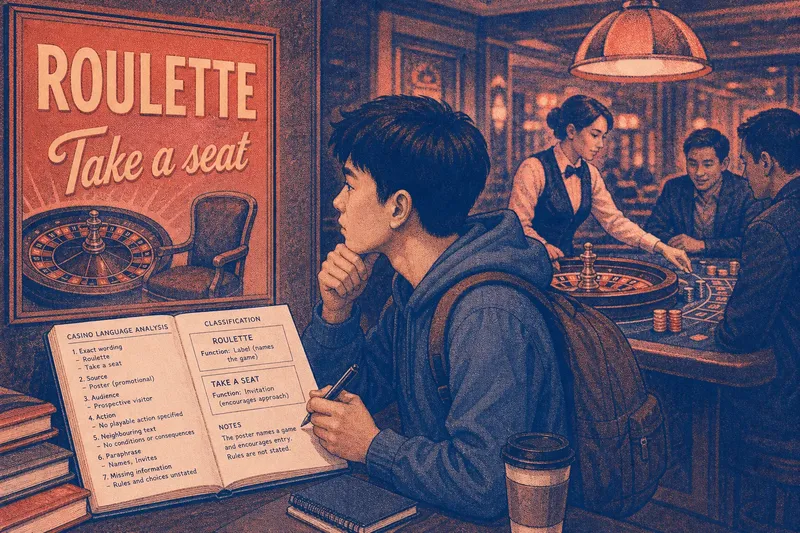
The common mistake with casino table language is to treat every short phrase as a rule. A sign saying “Blackjack” names a game; “Place your bets” urges an audience to take an action, but does not explain the conditions for betting. For an NTTU student comparing a poster or scene, that distinction prevents a slogan from being mistaken for game procedure.
Read each phrase by asking what information it supplies. Does it identify something, describe an action, set a condition, or encourage someone to approach? Those functions can sit side by side without becoming interchangeable.
Why is casino table language easy to misread?
A felt layout, poster or dialogue scene can put game names, directions and decorative slogans close together. Their proximity may suggest they belong to one set of rules, though the text itself may not connect them. A prominent label still names; it does not become a rule merely by being printed beside a prompt.
Tone can mislead as well. “Take a seat” has the grammar of a command, but on a promotional poster it may invite a passer-by to approach. “The dealer deals two cards” sounds neutral and describes an action; it does not direct a player to do anything.
Ask what a reader could learn by following the phrase literally. If it names an object or encourages entry but gives no playable action, condition or consequence, it is not enough to explain a game rule.
How do instructions differ from labels?
An instruction tells a participant what action to take or explains what choice or condition applies. Words such as “draw”, “stand”, “bet” and “pass” may appear in instructions, but a verb alone does not settle the matter. “Players draw cards” can describe a procedure rather than command a particular reader.
A label identifies a game, object, place or role. “Roulette”, “dealer”, “shoe” and “payout table” can help a reader locate or name something without explaining what to do. They are useful landmarks, not miniature rulebooks.
Check the source, intended audience and surrounding wording. A rules panel may define a choice; a character’s dialogue may describe an action; a banner may simply draw attention. Treat the genre as a clue, then use the actual wording to support your reading.
What does an invitation do?
An invitation encourages attention, entry or participation. “Join the table” and “Try your luck” address a prospective visitor, not necessarily a player making a move. They can shape a scene’s mood—welcoming, urgent or playful—without specifying how play works.
Imagine an NTTU student analysing a fictional casino poster with the heading “Roulette” and the line “Take a seat”. The student records “Roulette” as the game label and “Take a seat” as an invitation to approach. Since neither phrase states a player’s options or what follows a choice, the student’s comparison can say that the poster names a game and encourages entry, while leaving the rules unstated.
How can you classify a phrase in your notes?
Use this short check on each phrase, rather than assigning a function from its position or tone alone:
- Exact wording: Check the phrase and its punctuation; if a condition appears in the surrounding line, include it, otherwise note that the condition is absent.
- Source: Check whether it appears on a rules panel, sign, poster or in dialogue; if the source supplies procedures, assess the phrase as part of them, otherwise avoid assuming it is procedural.
- Audience: Check whether it addresses a player, names something for a reader or speaks to a prospective visitor; if it addresses a player’s choice, consider an instruction, otherwise consider a label or invitation.
- Action: Check whether it specifies a move or action; if it does, look for a condition or consequence, otherwise classify it as description, label or invitation according to context.
- Neighbouring text: Check whether another line adds a condition; if it does, read the lines together, otherwise keep the first phrase’s limits clear.
- Paraphrase: Check whether your description claims more than the phrase says; if it does, replace it with “names”, “describes”, “directs” or “invites”, otherwise retain the supported wording.
- Missing information: Check whether the text states the relevant rule; if it does not, record that gap, otherwise quote the supplied detail rather than filling it in from memory.
The process works like reading labels on drawers: a label shows where to look, not what is inside. Familiarity with a game can help you recognise a term, but it cannot supply details missing from the particular text.
Which context clues should you check?
Start with layout, but do not let it decide the classification. Large lettering and bright colour can signal prominence; they cannot turn a game name into an instruction. A heading may identify the game while smaller text gives a direction, and a large slogan may be there to attract attention.
Then look at grammar and sequence. A statement that names an action and says when it occurs may describe a procedure. An imperative can still be an invitation. If a line is followed by conditions or consequences, those details may clarify whether it belongs to a set of rules.
Finally, consider the source’s purpose. A fictional scene, museum caption, promotional poster and rules sheet use language differently. That expectation helps frame a reading, but the words on the page remain the evidence.
What questions do readers ask about casino table language?
Can a phrase act as both a rule and an invitation?
It can carry more than one function, especially when promotional wording resembles a command. Describe each possible function and point to the context supporting it instead of forcing a single reading.
Does an imperative always direct a player?
No. “Join us” may address a passing audience, while “Stand” in a rules panel may name a player’s choice. Grammar is one clue; audience and context help establish the function.
Does a game name explain how play works?
No. “Blackjack” identifies a game but does not, by itself, explain its rules or choices. If the text omits those details, record the omission rather than supplying them from memory.
What if the same phrase appears on a poster and a rule sheet?
Read each appearance in its own setting. A phrase may encourage attention on a poster and have a procedural role in a rule sheet, depending on its surrounding text.
How should you present the distinction in a student comparison?
Make each claim traceable: quote the wording, state its function and name the clue that supports your reading. For instance, a comparison might say, “The sign names roulette; the nearby slogan invites visitors to approach; neither line explains a player’s choices.” The sentence separates the functions without claiming more than the text supplies.
If classmates disagree, compare the evidence. One reader may call “Take a seat” a command because of its grammar; another may read it as an invitation because it addresses visitors and gives no procedure. Record both observations, then assess them against the source and audience.
For a clear NTTU comparison, keep labels, invitations and instructions distinct in your notes, and flag any rule the source does not state. That final gap is useful evidence: it shows where the text ends and interpretation must begin.