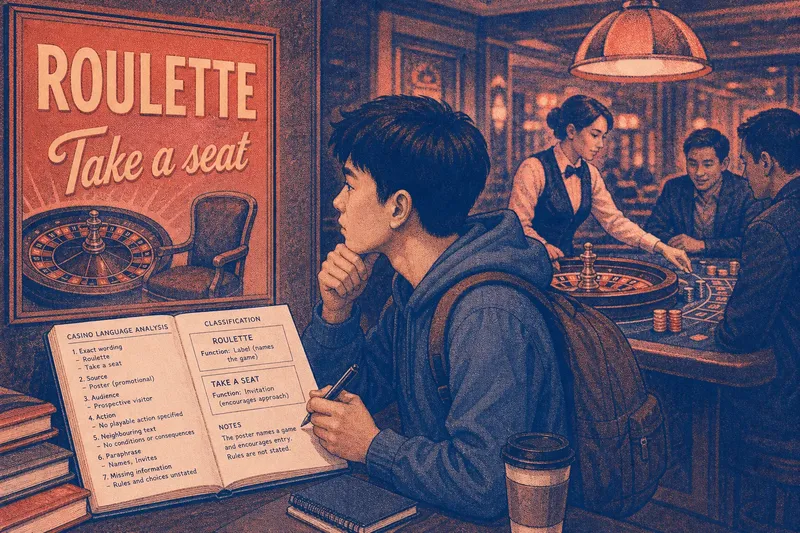
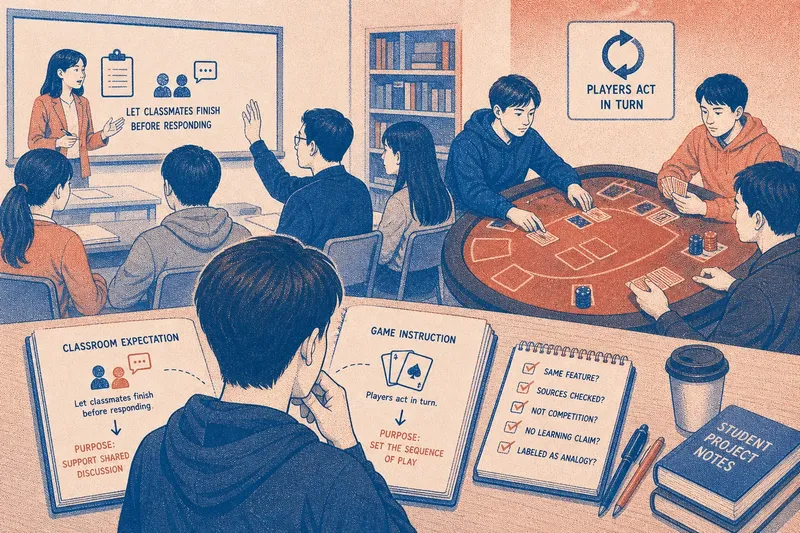
When Casino Images Enter Student Discussion
Casino imagery in student discussion can help NTTU students compare how films, adverts and games frame chance, without confusing symbols with their wider messages.
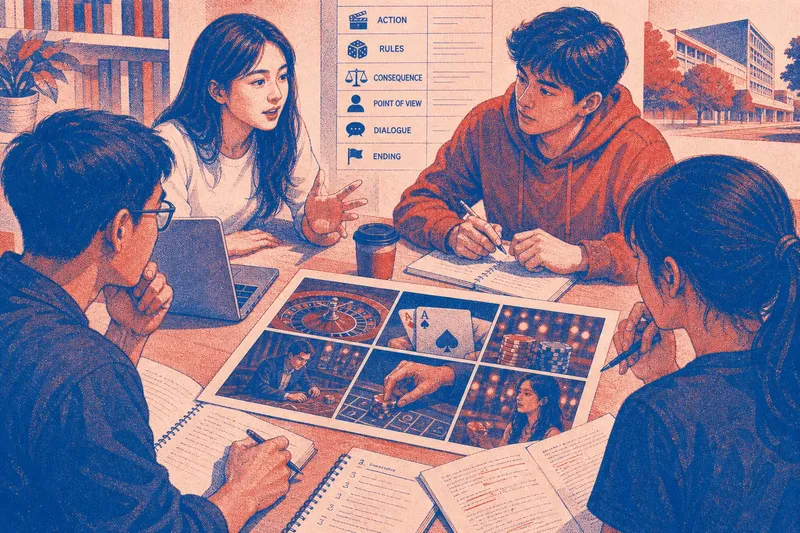
The common mistake in discussing casino imagery is to treat a roulette wheel, playing card or neon sign as decoration with an obvious meaning. That shortcut costs the group a better question: how does the image borrow the language of games to make chance feel dramatic, sociable or routine?
At Đại học Nguyễn Tất Thành (NTTU), students can approach casino scenes as cultural storytelling rather than a puzzle with one hidden answer. The useful focus is how a source turns uncertainty into a story: through a character’s choices, the rules of a game, or the consequences shown on screen. A playing card can serve as a prop; the sequence around it gives it a role.
How do stories turn chance into drama?
Games have built-in uncertainty: a player makes a choice, an outcome follows, and the rules make that outcome legible. A film or advert can borrow this structure even when no game is being played. A character may face a risky decision, while a cut to a wheel or a hand of cards gives that decision a recognisable shorthand.
For discussion, trace the story’s chain of action rather than catalogue its imagery. Ask who chooses, what they stand to lose or gain within the scene, and what changes after the choice. This keeps the conversation on narrative construction, not on assumptions about what actual players think or do.
What do game rules contribute to a casino scene?
Rules make a scene’s uncertainty specific. If a character is playing blackjack, the audience can understand that a decision is constrained by the game’s rules. If the film never identifies the game, do not supply a rule set from memory; describe the scene as an uncertain contest and leave the details open.
Rules also create different kinds of tension. A scene may emphasise a player’s decision, an opponent’s response or the reveal of an outcome. These are distinct story devices. A close-up of a card is less informative than the sequence that explains why that card matters to the character.
Think of rules like the markings on a board game: without them, a move may look dramatic, but its consequences are hard to follow. The analogy is about storytelling, not a claim that casino games are interchangeable.
How can students discuss a scene without overstating it?
Keep three things separate: what happens in the story, how the scene presents it, and what remains unclear. For instance, “the character places a bet” is a plot description if the action is visible. “The pause makes the decision feel consequential” is an interpretation. “The character’s motive is not explained” marks a limit.
- Action: Check whether the scene shows a character making a choice. If it does, describe the visible action; if it does not, avoid claiming that a choice occurred.
- Rules: Check whether dialogue, labels or play makes the game identifiable. If they do, name the game and use only relevant rules; if not, call it an unspecified game and do not infer its mechanics.
- Consequence: Check what changes after the play or reveal. If the scene shows a clear change, describe it; if no consequence is shown, do not claim the outcome altered the character’s circumstances.
- Point of view: Check whose experience the scene follows. If the sequence stays with one character, discuss that character’s perspective; if it shifts, note the shift rather than treating the scene as a single viewpoint.
- Dialogue: Check whether characters explain their motives or the stakes. If the words support a motive, quote or paraphrase the relevant line accurately; if they do not, leave the motive unsettled.
- Ending: Check whether the scene resolves the game or cuts away. If it resolves the action, describe the ending shown; if it cuts away, distinguish the unresolved result from any later events.
What questions help analyse a casino story?
Why does a film use a game instead of another contest?
Consider what the game’s rules allow the scene to show, such as a choice under pressure or a result that arrives unexpectedly. If the story gives no particular reason, describe the device’s visible function without assigning a deeper intention to the filmmaker.
How does a character’s choice affect the plot?
Follow the action before and after the choice, noting only changes the story actually presents. If the consequences are withheld, say that the scene leaves the choice unresolved rather than predicting what follows.
What if the game is never identified?
Use neutral language such as “a card game” or “a casino game” when that is all the scene establishes. Do not import rules from roulette, poker or blackjack merely because a familiar object appears.
Can a scene make chance seem fair or unfair?
Describe how the story distributes information and outcomes: for example, whether viewers see a character’s decision before the result. Treat “fair” or “unfair” as an interpretation of the scene’s design, not as a claim about real gambling.
How does a worked reading stay tied to the story?
Say a student group chooses an invented, hypothetical short scene with three stated elements: one character, one card game identified in dialogue as blackjack, and a final shot that reveals the hand. The group writes down the starting situation: the character has one visible hand, the opponent has one visible hand, and the rules are named but not fully explained.
First, the group records the action: the character asks for another card, then the scene shows the result. Second, it checks the dialogue and notes that the character says they are trying to recover a lost keepsake; this supports a stated motive, though it does not establish the character’s wider financial situation. Third, the group records the ending: the shot shows the character’s hand losing to the opponent’s. The resulting reading is that the scene links a game decision to the character’s attempt to recover the keepsake, while the limited setup does not support claims about broader consequences. If the final reveal were absent, the group would instead record the outcome as unresolved.
How should casino stories be compared?
Compare the same kind of story element across works. One useful comparison is how two scenes make a decision consequential: does the story explain the rules, show the choice and reveal the outcome, or leave one of those parts out? Another is how a character’s stated motive relates to the game. Avoid treating a shared roulette wheel or card table as evidence that two stories make the same point.
For casino imagery in student discussion, the practical question is how a story uses the language of games to organise choice and consequence. Identify the game only when the source does, follow the action the scene actually shows, and leave missing motives or outcomes open. That gives an NTTU seminar something sturdier to discuss than a pile of familiar symbols.